In 1981, Sinclair released a computer at a price that is still crazy
30 years later: $99.95. The Timex Sinclair 1000, also known as the ZX81,
was small, ran on BASIC, and offered a mere 2KB of RAM
to go with its 3.25 MHz processor. Even by 1981's standards, it was
slow -- but it also cost a mere 100 bucks, making it an attractive entry
point for aspiring hobbyists who couldn't spend a thousand dollars on a
PC.
Thanks to its price, the Timex Sinclair 1000 sold over 600,000 units in the United States [source: Old Computers].
The Timex Sinclair 1000's performance was infamously slow--because the
computer contained a mere four chips, it relied on its CPU to handle all
of its processing and refresh whatever external display it was attached
to. Switching to "FAST" mode would speed up calculations but cause a
terrible screen refresh rate. Thankfully, the computer supported tons of
expansions, like floppy drives and RAM add-ons, that greatly improved its functionality.
Ah, Radio Shack. Once upon a time, it sold computers
under its very own brand. And they were hugely successful. In the
1970s, when cassette tapes, and not floppy disks, were the go-to storage
medium for computers, Tandy put out a personal computer called the
TRS-80. Thanks to the TRS-80, the Tandy name was as big as IBM or Apple or Commodore in the PC market of the 1980s.
The TRS-80 launched in 1977, before the home computer market had
really exploded. Tandy offered its first model with 4K of RAM, a 1.77
MHz processor and a 12-inch monitor for $600. Later models and a $300
Expansion Interface greatly increased the computer's capabilities,
adding floppy support, extra ports and more memory [source: Goldklang].
Tandy's TRS-DOS (disk operating system) was a popular OS predating
MS-DOS. Microsoft's early operating system bore some similarities to
TRS-DOS -- no surprise, since Tandy sold more than 200,000 units and
followed the TRS-80's success with more popular systems such as the 1980
Color Computer, or CoCo [source: Old Computers].
While the United States and European markets were ruled by companies like IBM, Commodore, Sinclair and Apple,
Japan had its own hardware giants in the '80s. The MSX is a unique
computer, because its name -- which could stand for Microsoft Extended
Basic or Machines with Software Exchangeability -- actually applied to a
number of similar systems created by Japanese companies like Toshiba
and Sony.
MSX was designed to be a hardware standard and was spearheaded by Microsoft
Japan's Vice President Kazuhiko Nishi. The computers used Microsoft
BASIC and weren't as expensive as some other computers of the 1980s.
Since the launch of MSX in 1983, the computer family has sold more than 5
million units [source: Lyon].
MSX never became a global hardware standard, but it was very successful
in Japan (as some video game fans know, Metal Gear was originally
released on the popular MSX before Nintendo's Famicom).
 The NEC PC-98 line was extremely popular in Japan.
While the MSX was a popular range of Japanese computers united by a
common set of hardware standards, NEC's PC-98 was a monstrous success
all by its lonesome. Released in 1982, the PC-98 ran on a 5 MHz Intel
8086 CPU, had two display controllers, and a base 128KB of RAM.
The PC-98 was a powerful computer for its time, and NEC ruled the
Japanese market with roughly a 50 percent market share, thanks to the
system's success.
While the 1980s computer market was eventually dominated by IBM PCs
and IBM knock-offs, NEC's unique architecture ruled in Japan. The PC-98
line sold more than 15 million systems over a lifetime of more than a
decade, though NEC obviously released multiple updates to the computer
over that lifetime -- the original PC-98 launched in 1982 didn't rack up
all of those sales itself [source: Computing Japan].
Even so, NEC was Japan's go-to computer company in the 1980s, making the PC-98 the eastern equivalent of the mighty IBM PC.
6. iMac
Not visible here: The handle on the top of the all-in-one iMac that made
it easy to carry. And tempting to throw in times of frustration.
The iMac
is the exception to the rule of modern computing that no single model
is unique enough or popular enough to match the fandom of groundbreaking
'70s and '80s computers. Of course, that was Apple's point. When they
released the iMac in 1998, they advertised its colorful body by
criticizing the beige color of drab PCs.
Today, Apple's moved away from the candy colored aesthetic for the
iMac, but the computer's main draw remains unchanged. It's a simple,
all-in-one design that incorporates all of the computer's components
into the monitor housing. Easy to move, easy to set up.
The iMac was the beginning of a new era for Apple, which would usher
in tremendous success with "i" products such as the iPod and iPhone.
The iMac was never a massively successful product line -- Apple struck
gold a few years later with its MacBook and MacBook Pro laptops -- but
it was still the first Mac in years to make a dent in the
Microsoft-dominated PC market of the 1990s.
The iMac also rebranded Apple as a style-conscious company worthy of
imitation. In 1999, they sued a pair of computer companies for ripping
off the iMac's look, which they'd promoted with a $100 million marketing
campaign [source: McCarthy]. Given their success with virtually every product released since the iMac, that campaign was likely a worthy investment.
5. Commodore Amiga
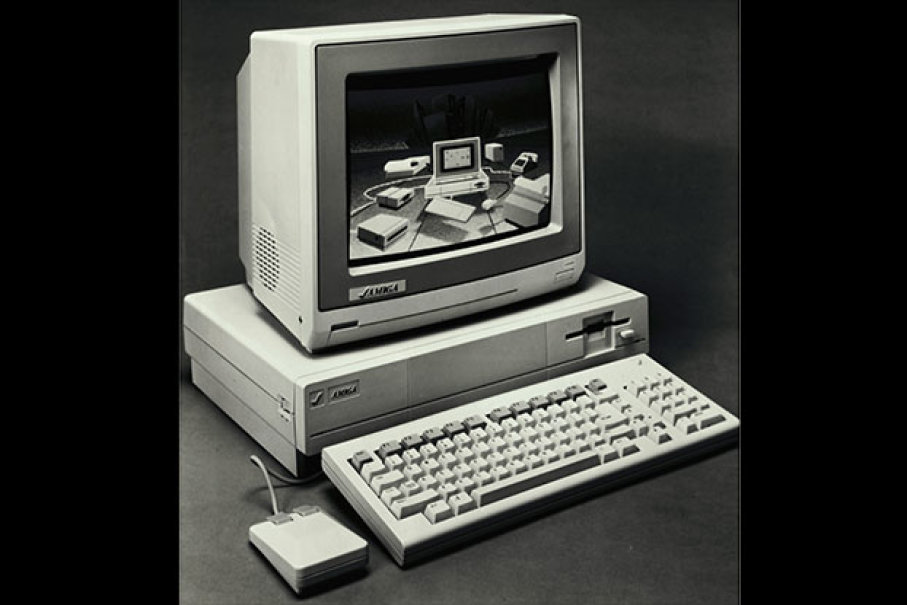
The Amiga computer offered high speeds and quality graphics at an affordable price.
The Amiga 500, released in 1987, followed in the footsteps of wildly successful computers
like the Commodore 64 and Apple II. It was newer, faster, better: The
Amiga 500 made the jump from an 8-bit CPU up to 32 bits and 7 MHz of
speed. The computer shipped with 512KB of RAM, support for up to 4096 colors, and an internal 3.5-inch floppy drive. Not bad for a launch price of $700.
The Amiga was a speedy computer, thanks to a design featuring
multiple coprocessors that were dedicated to certain duties such as
audio or video. The central processing unit didn't have to do everything
by itself. Commodore released many Amiga models over the course of a
decade, but the inexpensive 500 was the most popular. The Amiga was an
especially popular software platform for games and creative programs for
video and sound work. Thanks to its coprocessors, the Amiga was
powerful enough to do graphic and animation work previously impossible
on a consumer PC.
Overall, the Amiga family sold approximately 6 million units -- an
amazing number for any computer launched in the 1980s [source: Amiga History Guide].
4. Apple II
Steve Wozniak, designer of the Apple I and II series, shows off an Apple IIe. And a great belt buckle.
In 1977, the same year Sinclair released the $100 Timex Sinclair 1000, Apple
released the Apple II. Apple's second hobbyist computer cost a bit more
than the Sinclair at a starting price of about $1300, but there's a
reason one company no longer exists and the other is the richest
corporation on the planet. The Apple II was an incredible success. It
built on the design of the Apple I by retaining a simple 1MHz processor
and 4KB of RAM and adding a case and keyboard.
Eight expansion slots on the Apple II board made the computer
extremely customizable for hobbyists, and the system could be configured
with up to 48KB of RAM. That was a ton in 1977. But it was software
that truly set the Apple II apart. Apple's Steve Wozniak designed an
affordable 5 1/4-inch floppy drive add-on, the Disk II, that was
relatively inexpensive to produce, thanks to a new software approach to
reading and writing. More importantly, spreadsheet software VisiCalc
made the computer a powerful tool for corporations, who were perfectly
willing to pay more than $1000 per machine.
The Apple II was one of the best selling computers on the market for
five years, selling more than 1 million units in the young computer
market, spawning offshoot models like the Apple IIe, and placing Apple
on the Fortune 500 list [source: Old Computers].
Apple introduced the Macintosh in 1983 and had sold 1 million units by
1987. While the Macintosh name has stuck, the Apple II made a tremendous
impact on the computer industry.
3. ZX Spectrum
A Sinclair ZX Spectrum computer on display at the Science Museum in London, 2006.
While computer company Sinclair found success in the United States
with the Timex Sinclair 1000, its greatest contribution to the industry
was the ZX Spectrum, launched a few years later in 1982. The design was
similar: The Spectrum was a small, affordable (£ 125 in the U.K.) system
that incorporated a keyboard into its body. But the Spectrum was a much
better computer than its predecessor thanks to 16KB of RAM and a real hardware keyboard (the Timex, known as the ZX-81 in the U.K., had a poor plastic membrane keyboard).
The ZX Spectrum line was successful worldwide, selling more than 5 million units during its lifetime [source: Old Computers].
But the Spectrum is also the computer that brought the PC into the home
in the U.K. It was the first computer many people owned. The Spectrum
launched hundreds or thousands of careers, as young hobbyists discovered
a passion for computers thanks to the affordable machine. For British
IT and video games, it all started with the ZX Spectrum.
2. IBM PC
A 3.5-inch floppy disc (remember those?)
from a IBM PC Convertable. The historic machine was on display as part
of the 25th anniversary of the Electronic Communications Privacy Act in
2011.
Today's non-Mac personal computer
is, essentially, an IBM PC. The Intel-based, Windows-running computers
that have dominated the market since the 1990s were born from the IBM
PC, which was released in 1981 with a humble 4.77 MHz Intel 8088
processor and 16KB of RAM. IBM Model 5150 wasn't the company's first
effort to move into the personal computer market -- they'd released an
expensive PC back in 1975 -- but it was the one that did everything
right. The system wasn't the fastest around, but it was equipped with
Intel's 16-bit processor, rather than the older 8-bit processors most
computers at the time were using. Despite being a new chip, the 8088
used an 8-bit bus, making it compatible with existing peripherals and
memory expansions [source: Reimer].
The IBM PC cost about $1600 in a base configuration, which was
affordable for a powerful computer at the time. The system was popular,
and software was coded specifically to take advantage of IBM's design
and maximize the Intel 8088's performance. So, other companies cloned
IBM's BIOS and put out IBM PC clones.
Within a few years, all x86 computers -- those using Intel's
processors -- were compatible with the IBM PC and virtually identical to
IBM's design. They all ran MS-DOS, and the x86 PC field went on to
become the de facto standard. There's only one reason the IBM PC isn't
the most popular computer ever made -- too many other companies made
their own versions!
1. Commodore 64
The Commodore 64 never caught on in Europe or Asia the way it did in the
U.S., but it still reached plenty of users. Here, German children try
out a model in 1985.
The Commodore 64 is the single most popular computer system ever
sold. Released in 1982, the Commodore 64 had a 1MHz CPU and two big
draws: a powerful, programmable sound chip and powerful graphics for a
1982 computer. Even better, the Commodore 64 cost a reasonable $595 and
had 64KB of RAM (hence the name). And the Commodore 64 could be plugged into a TV, making it a hybrid computer/video game console.
When it was released in 1982, the Commodore 64's graphical
capabilities beat the pants off other popular computers like the Apple
II. Thanks to its price, the Commodore 64 sold well. And it kept
selling. As the computer became cheaper to produce, Commodore cut the
price, keeping it popular throughout the 1980s. It continued to be
produced until 1994.
Affordable modems
made the Commodore 64 a great computer to get online with, and like
most systems of the day it used the BASIC programming language. It was a
popular software platform. By the end of its life, the Commodore 64 had
sold more units than any computer before or since. Estimates vary from
as few as 12 million to as many as 30 million. The Commodore 64 likely
sold an incredible 17 million by the end of its life [source: Old Computers].


 Twitter is a service provider website of social networking and
micro-blogging. It allows users to read and send the message. You can
share link, share text tweet to the followers. You can even receive and
send any private message.
Twitter is a service provider website of social networking and
micro-blogging. It allows users to read and send the message. You can
share link, share text tweet to the followers. You can even receive and
send any private message.